Wednesday, 6 August 2014

Recurring themes #2 (Drip painting)

Autumn Rhythm (Number 30), 1950

I started drip paintings closer to the second half of the 1940s, mainly between 1947-1950. There is a heavy use of the black and white industrial enamel paint here, overlapping each other in harmony. The steaks of paint spread relatively evenly across the surface of the canvas, treating every colour which equal importance. That is mainly the gist of most of my drip paintings. 

However, closer to the period of 1950s, I began to abandon the use of a colourful palette or even muted tones of any other colours others than black and white... I wanted to focus just on black and white colour instead. There are artworks which showed an increased use of black and white colour. Such paintings are The Deep, and Yellow Islands.

Yellow Islands, 1952

The Deep, 1953
Thus, seeing from these two artworks, I have increasingly began to utilise more black and white colour while abandoning the colourful palette. This phase of development marks the last few productive years of my professional artist career period although I still continued to paint on my own leisure after that. My painting has changed from being semi-realistic to figurative and then to expressionistic in a period of around two decades. I believe I have reached the peak of my Abstract Expressionist development...

Recurring themes #1 (Early works)

My artwork have seen a huge change from the period of 1930-1940s. I would like to present my painting style during the early period. In 1930, i moved to New York City to live with my brother, Charles. Well, I studied with Charles' art teacher, Thomas Hart Benton and he had influenced the way I painted. Benton was an American Regionalist painter and some of my works exhibited the scene of rural life such as Going West (1934-1935), where I painted a pioneer journeying West. There are swirling forms which evoke emotional intensity and the colour palette has a rather dark quality. However, this period only lasts for a while...

Going West, 1934-1935

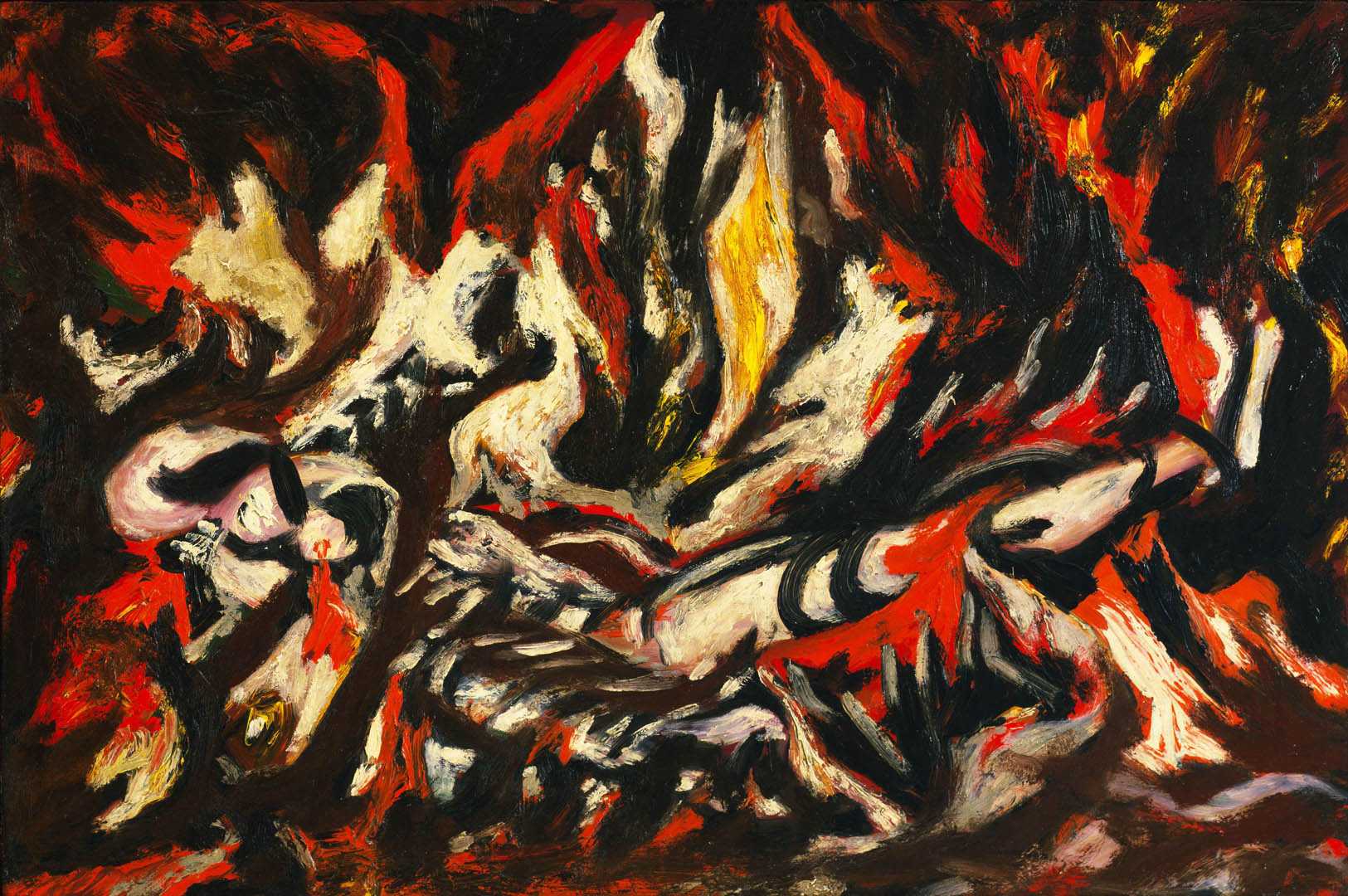
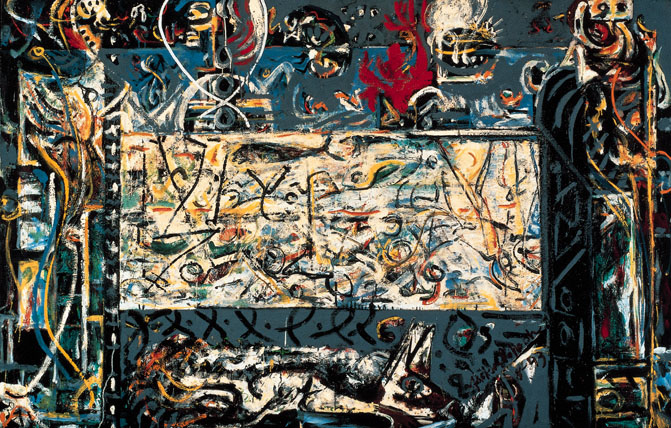
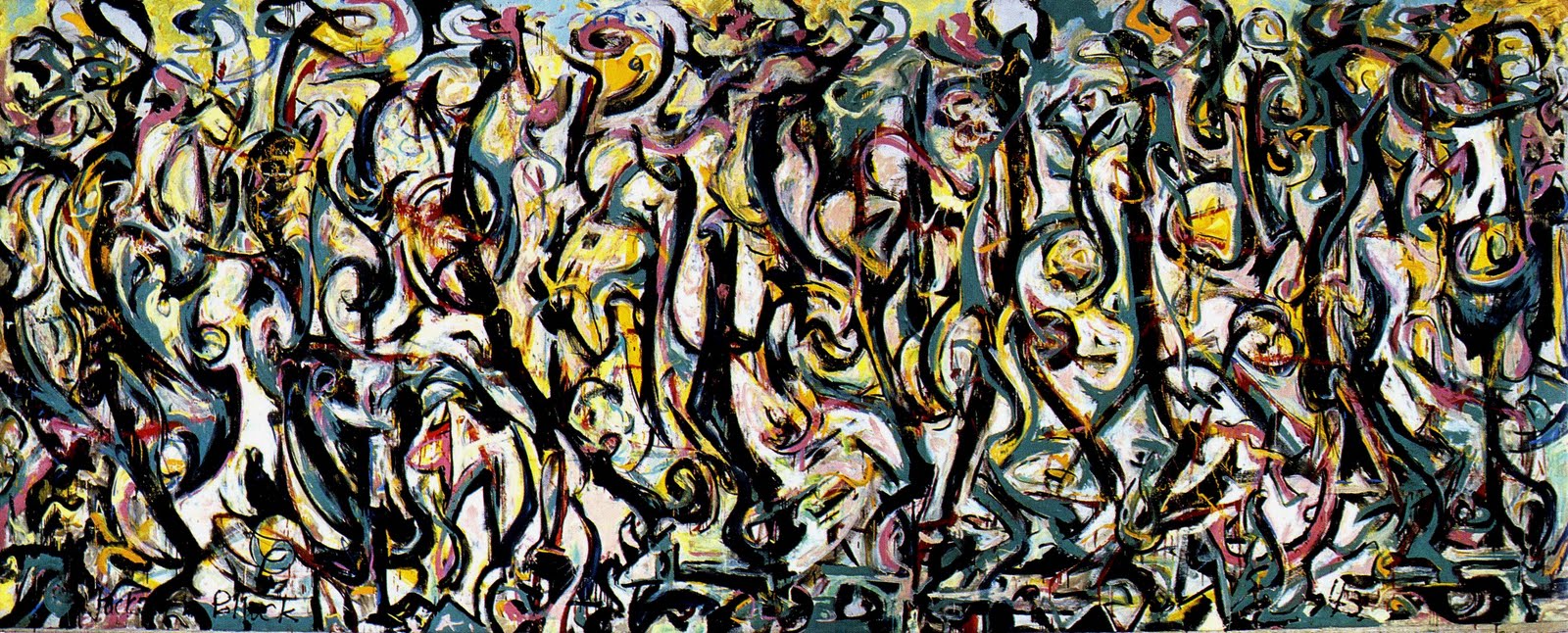
There are also signs of my paintings changing for the better. My subject matters became more figurative and the colour scheme became increasingly colourful. I started to employ more curvy and sinuous lines which became dominant in my later works. Such paintings which shows the transition phase of my painting are The Flame, Guardians of the Secret and Mural, among many other paintings that I have done.


The Flame, 1934-1938

Guardians of the Secret and Mural, 1943

Mural, 1943

As you can see my paintings also begin to have similarity with my beloved wife, Lee Krasner's works. 'Mural' painted by myself is a piece that shows my progression towards drip paintings. The colourful palette and sinuous lines start to show up. Here's a work by my wife:

Shell-flower, 1947
This post thus summarises the development journey of my painting career. Next up, I'll be talking more about my drip paintings...

Influences (Agnes Cecile)

This is a continuation of the post from yesterday (Lee has been nagging me the entire day to finish up this, while I'm having a splitting headache from the hangover).

So. Agnes Cecile is a painter who is famous for her water color paintings that makes use of drips as well.

I quite enjoy looking at her works as even though the subject matter is entirely different from mine, I like her control and confidence when handling the paint. Aside from it still being a figurative piece with no abstractions so to speak, she is able to condense her emotions and feelings into the streaks of paint and convey them without having to explain anything. Just like what I always try to portray in my works.

Making of Frail Lull

Lines hold the memories

I just want to say that it is interesting how 'drip paintings' have become a technique many artists nowadays are using as well, and how it is still appreciated as a way of presenting a statement.

Agnes Cecile's website: http://agnes-cecile.deviantart.com/

Anthony Poon and Me, and maybe Piet Mondrian


Top: Aqueous Waves, 1987 by Anthony Poon
Bottom: Number 8, 1949 by ME

Yes I love my works and I take pride in them. Hence this blog on me and my works. By me. ME.


 I have the very fortunate opportunity to take a look into the future again and I found this very intriguing artist in Asia by the name of Anthony Poon. He reminds me quite strongly of my close friend back at home, Piet Mondrian.

In this painting that I took as an example of his, I see once again the disciplined straight and calculated composition. Except this time, it is even more pronounced than in Piet’s works. The clean and rigid lines of his waves contained within square-like areas look a lot like sine and cosine graphs actually. The controlled and carefully constructed curves are so rigid, making the painting lack emotional and personal input. This irks me so much. >(

I used my ‘Number 8’ as an example to show how different our styles are. In ‘Number 8’, there are lots of curves made distinct by black paint splattered on a light colored background. This would become my basis of comparison, as the curves in my painting are almost the exact opposite of the controlled waves in Poon’s painting. They are almost random and placed haphazardly on the canvas due to the nature of my painting process. They are unrestricted and free in a sense that the splashes are allowed to go where they wanted after leaving my brush, as compared to the controlled way paint is used in Poon’s work.

While Poon may have put an emphasis on the calm, tranquil effect his sleek waves have evoked, I put emphasis in the chaotic, free and provocative effect my work evokes in my viewers’ eye. Our work are polar opposites that are only united under the common title of ART. Freedom rules. 


Reply to Brancusi (comment on previous post)

Comment from Brancusi:

"Now you've got my attention, what are the works that make yours and Bansky's similar? Please don't leave me with a cliffhanger like this! This internet is so interesting and eye-opening, so is this generation, I share your surprise at the freedom to draw on the streets (it is legal right?)
Tell me more please:D
Brancusi"


Good friend, so glad to hear from you! Are you still not opening to public that wonderful collection of works of yours? I do like your abstraction a lot you know.

I do think that there isn’t a specific work of Banksy’s and mine that are similar, but rather the idea and concept behind most of his works. It is clear to me that Banksy and I share a very similar nature. We do not like to be confined to common conventions and we have expressed it in our art.


Graffiti in the modern world is the epitome of freedom, in which no surface is forbidden as long as you can reach it. And in America, it is legal! I find that quite similar in the way my paintings are executed: all canvas surface is fair game as long as I can get the paint there. The issues raised in Banksy’s art are challenges to the governing organization, highlighting questionable policies and points of views. I see this as a rebellious attitude towards societal conventions and I must say I approve of him.

Piet Mondrian and Me

Image result for broadway boogie woogie
Broadway Boogie Woogie
1.27m x 1.27m
Piet Mondrian
Number 5
2.4m x 1.2m
Me                                                                               


Broadway Boogie Woogie is an art piece created by my close friend Piet Mondrian, following the rules of De Stijl very closely. It consists of rectangles and squares in the primary colors of yellow, red and blue arranged in an orderly manner. The composition of the angular forms is controlled and appears to be very carefully calculated and planned.

In my opinion, the use of colors in our pieces are quite similar for this case. In my ‘Number 5’ I used the primary colors primarily. Red and blue in the background while the yellow acted as highlights in the foreground. There isn’t really much of a composition at first glance but I do have an image of how I wanted the painting to turn out.

Although we both used abstraction in our paintings, it is a really different form of abstraction we both seek to express. While Piet took pride in the rigid, composed arrangement of carefully painted right angles of his paintings, I took pride in my seemingly barely controlled, wild look of my splattered paint.


To keep to the stiff and unforgiving rules of De Stijl is just not my style, I cannot bare to constrain myself to the straight lines evident extensively in Piet’s painting. I want to break free and be as wild as the canvas allowed me too. To be as orderly as Piet is just not in my nature.